• Call For Papers

    As global challenges like poverty, climate change, and systemic inequality persist, dominant Western development models are proving insufficient, often sidelining Indigenous Knowledge Systems (IKS). These systems offer valuable, locally grounded, and sustainable alternatives rooted in environmental care, community wellbeing, and long-term planning. This international academic conference aims to re-center IKS and their “wise practices” from across Africa, Canada, and beyond, highlighting their potential to transform development paradigms. Scholars, practitioners, and Indigenous knowledge holders are invited to share insights, case studies, and collaborative works to explore how IKS can inform inclusive, resilient, and decolonized approaches to sustainability and well-being. Interdisciplinary and community-led contributions are especially encouraged. Submission Guidelines Abstracts: 200-250 words Deadline for Abstract Submission: September 30, 2025 Notice of Acceptance of Abstract:  October 30, 2025 Deadline for Full Paper Submission: February 28, 2026

  • Africa Indigenous Knowledge Research Network (AIKRN) QUARTERLY WEBINAR SERIES

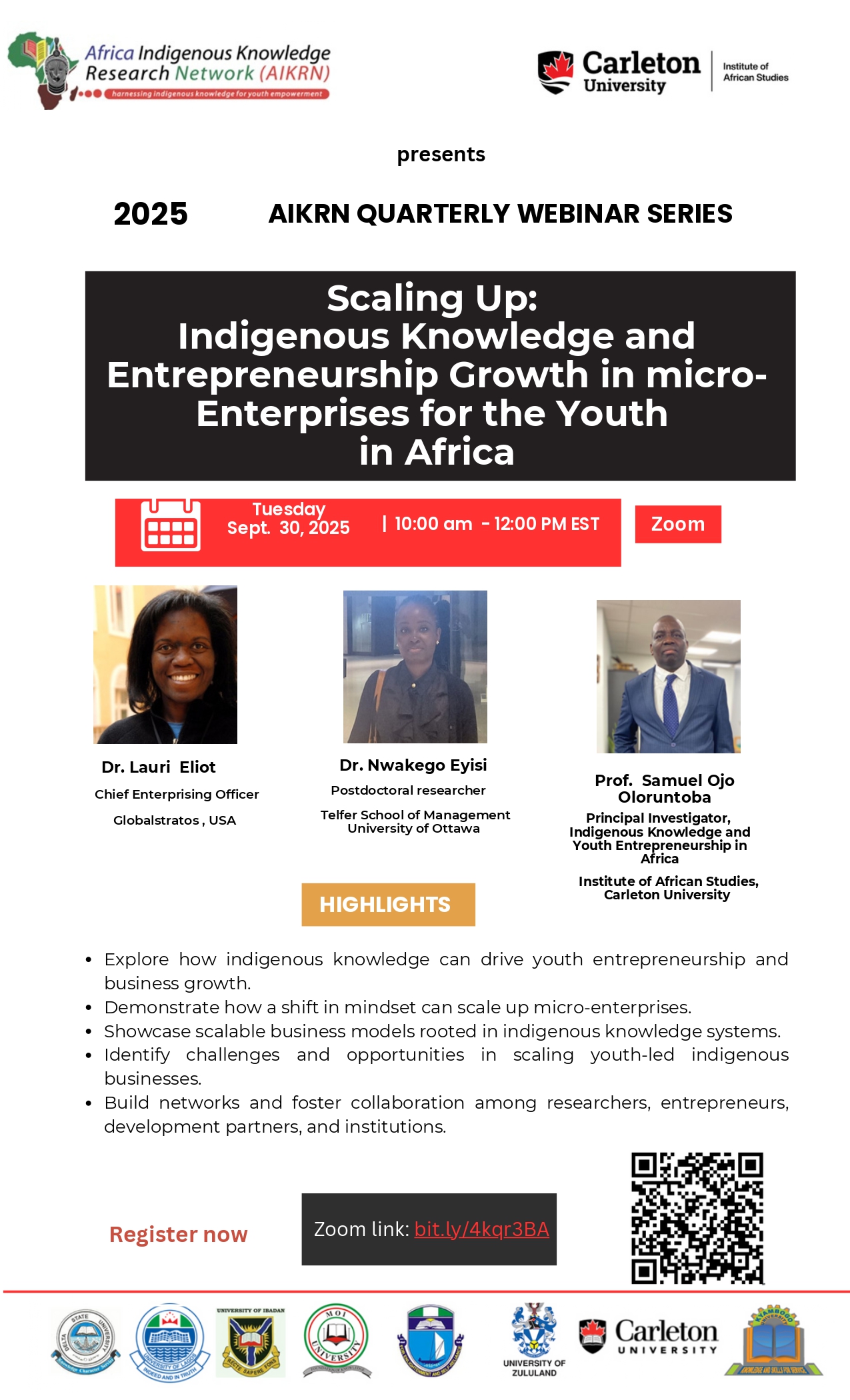
    Scaling Up: Indigenous Knowledge and Entrepreneurship Growth in micro-Enterprises for the Youth in Africa September 30, 2025 Time: 10:00-12:00PM EST Speakers: Dr. Lauri   Eliot and Dr. Nwakego Eyisi Chairperson: Professor Samuel Ojo Oloruntoba Background and Rationale: Across Africa, indigenous knowledge systems (IKS) have long served as the foundation for resilience, innovation, and socio-economic survival. From traditional medicine and craft industries to food systems and local environmental management, indigenous knowledge is deeply rooted in the wisdom, culture and norms of the people. It is rooted in community life and offers tremendous untapped potential for entrepreneurship and inclusive economic growth. Africa’s youth—who make up over 60% of the continent’s population face the perennial  urgent challenges around unemployment, underemployment, and limited access to dignified economic opportunities. In this webinar, speakers will explore how the  intersection of indigenous knowledge and entrepreneurship offers a promising pathway for business development, youth empowerment, and sustainable livelihoods, especially when scaled and supported with enabling policies, finance, and innovation ecosystems. This webinar  is  organized by Africa Indigenous Knowledge Research Network in partnership with the Mastercard Foundation. It  aims to foster dialogue, share insights, and showcase success stories and innovations that demonstrate how youth in Africa are transforming indigenous knowledge into scalable business ventures. It also seeks to examine how academic institutions, policymakers, private sector actors, and development organizations can collaborate to amplify these efforts and create an ecosystem for sustainable indigenous entrepreneurship. Objectives: To explore how indigenous knowledge can be leveraged as a driver for youth entrepreneurship and business growth in Africa. To show how a shift in mindset can help to scale up micro-enterprises by applying indigenous knowledge in Africa To showcase scalable business models rooted in indigenous knowledge systems. To identify challenges and opportunities in scaling youth-led indigenous businesses. To build networks and foster collaboration among researchers, entrepreneurs, development partners, and institutions. To contribute to the discourse on decolonizing entrepreneurship and promoting African-centered innovation strategies. Expected Outcomes: Enhanced understanding of the value of indigenous knowledge in entrepreneurship and youth-led business growth. Identification of strategies for scaling up indigenous knowledge-based enterprises. Recommendations for policy, funding, and academic support mechanisms to promote indigenous entrepreneurship.   Participation: Please register here: https://carleton-ca.zoom.us/meeting/register/2RBj-1w0SjW0XITIZJVeXw Speakers Bio: Dr. Lauri Elliott has over 35 years of experience in strategy, innovation, organizational development, change management, human performance technology, business process reengineering, instructional design, large-scale system change, and technology. In addition, Lauri has over 22 years of in-depth business and strategy experience in developing markets, particularly Africa. As Chief Enterprising Officer of Globalstratos, Lauri assists small/start-up to large   companies to develop strategies and new projects/new ventures, focusing on early-stage development and pre-transaction activities in frontier and emerging markets. Lauri leads a team that develops methodologies for managing  and developing partnerships, designing and deploying early-stage projects/ventures, project preparation, and structuring organizations and systems to minimize risk and maximize opportunities while building sustainable enterprises. Lauri has developed, coordinated, and facilitated bi-lateral partnerships between the US and African institutions. She is the author of six books, including Redefining Business in the New Africa (2011) and Grow Rich in the New Africa (2012). She is also a frequent commentator on ETV South Africa and has been interviewed or quoted by other media outlets like SABC and Fox News.   Dr. Eyisi Nwakego Dr. Nwakego Eyisi is a development economist. She obtained her doctorate from the University of Nigeria. Nwakego's research spotlights the association between early-stage venture development and economic growth in emerging markets. Her study straddles the fields of strategic management and development economics. She has experience in new venture creation, small firm finance, and stakeholder (entrepreneurial) ecosystem development in Africa, where she spent several years researching and supporting historically excluded, colonized, and marginalized entrepreneurs. Nwakego has presented at international trade and development finance conferences. She is currently researching formal and alternative (indigenous ecosystems) models for developing entrepreneurship in emerging markets – Telfer School of Management. She has published papers in the Journal of the Knowledge Economy. She is an associate editor with Springer Nature. Nwakego has a master’s degree in applied economics from Eastern Michigan University. She is a member of the International Development Economic Associates (IDEAs) as well as the Africa Indigenous Knowledge Research Network (AIKRN). Her aim is that her research influences entrepreneurship policy.

  • AIKRN Quarterly Webinar – December 2025, Indigenous Health and Wellbeing: Opportunities for Jobs and Entrepreneurship for African Youth.

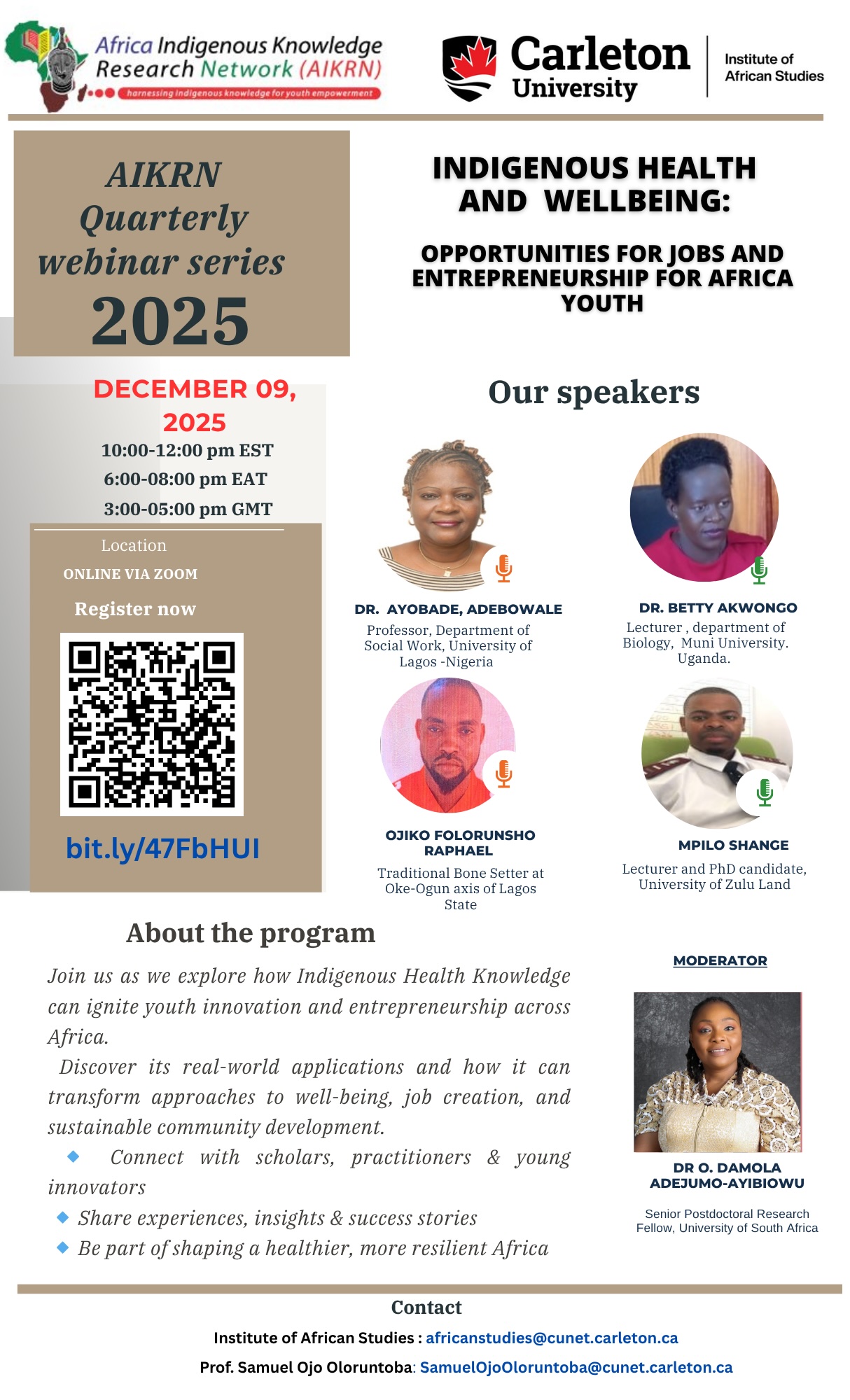
    The African Indigenous Knowledge Research Network (AIKRN) invites you to its Quarterly Webinar for December 2025, themed “Indigenous Health and Wellbeing: Opportunities for Jobs and Entrepreneurship for African Youth.” This engaging online event will take place on Saturday, December 6, 2025, from 10:00 AM to 12:00 PM (EST), 3:00 PM to 5:00 PM (GMT), and 6:00 PM to 8:00 PM (EAT) via Zoom. Participants from across Africa About the Program This webinar explores how Indigenous Health Knowledge can serve as a catalyst for youth innovation and entrepreneurship across the African continent. Participants will discover the real-world applications of traditional healing and wellness practices and how these can be integrated into modern systems to promote well-being, job creation, and sustainable community development. Through this discussion, AIKRN seeks to highlight the role of indigenous health systems not only as a cultural heritage but also as a viable economic and social resource. The session will bring together scholars, practitioners, and young innovators who are using indigenous approaches to create new models for healthcare, livelihood, and enterprise development. Attendees will have the opportunity to share their experiences, gain insights from experts, and participate in a collective dialogue focused on shaping a healthier, more resilient Africa. Meet the Speakers The event will feature an inspiring panel of professionals and community practitioners who are leading voices in indigenous health, research, and innovation. Dr. Ayobade Adebowale, a Professor in the Department of Social Work at the University of Lagos, Nigeria, will share perspectives on the social and community impact of traditional health systems and their connection to youth empowerment. Ojiko Folorunsho Raphael, a Traditional Bone Setter based in the Oke-Ogun axis of Lagos State, will discuss the practical applications of indigenous healing techniques and how such knowledge can be preserved and commercialized responsibly. Dr. Betty Akwongo, Lecturer in the Department of Biology at Muni University, Uganda, will speak on the scientific foundations of indigenous health knowledge and its relevance to modern health education. Mpilo Shange, a Lecturer and PhD Candidate at the University of Zululand, will contribute insights on integrating indigenous wellness concepts into academic and community programs. Dr. O. Damola Adejumo-Ayibiowu, Senior Postdoctoral Research Fellow at the University of South Africa, will explore how indigenous wellbeing models can inspire research and entrepreneurial pathways for African youth. The session will be moderated by Professor Samuel Ojo Oloruntoba from the Institute of African Studies at Carleton University, a prominent researcher dedicated to promoting African knowledge systems within global academic discourse. Participation and Contact The webinar is open to educators, students, entrepreneurs, health practitioners, and anyone interested in the intersection between indigenous knowledge and sustainable development. For general inquiries, participants can reach out to the Institute of African Studies at africanstudies@cunet.carleton.ca.Specific questions may be directed to the moderator, Prof. Samuel Ojo Oloruntoba, via SamuelOjoOloruntoba@cunet.carleton.ca.  

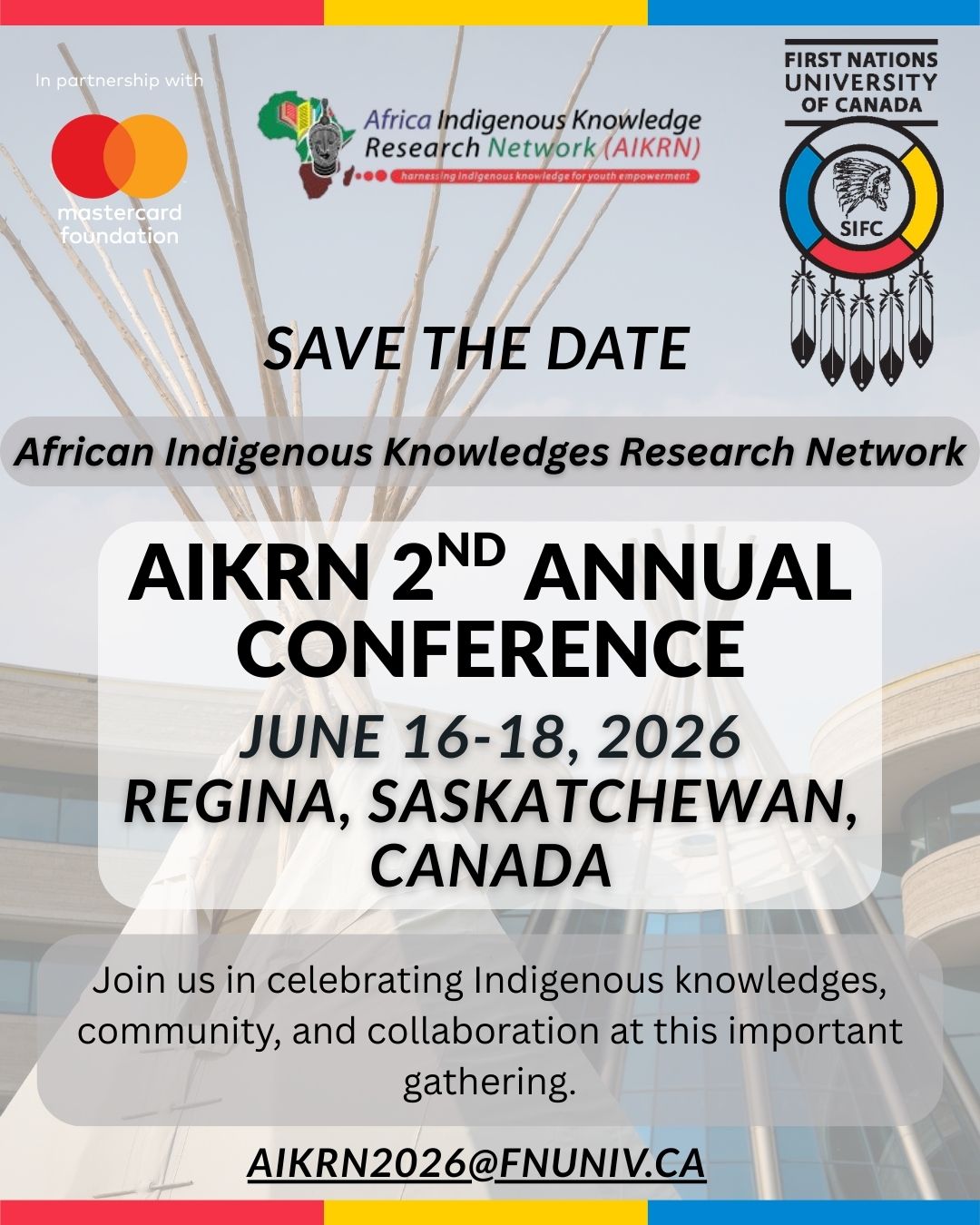
  • 2nd International conference of Africa Indigenous Research Network: ‘Indigenous Knowledge Systems and Transformative Wisdom: International Perspectives on Indigenous Economies, Entrepreneurship, and Sustainable Livelihood’.

    Carleton University, Ottawa.

    As global crises such as poverty, inequality, high rates of youth unemployment, climate change, unbridled environmental degradation, food insecurity, and systemic inequality persist, the limitations of dominant development paradigms—rooted in exclusionary, Western epistemologies—have become increasingly evident. These frameworks often marginalize Indigenous Knowledge Systems (IKS), despite their potential to inform sustainable, locally grounded, and equitable alternatives. Indigenous communities across the world possess complex knowledge systems that include epistemic ways of being, knowing, and doing. Wise practices from Indigenous Knowledges that prioritize environmental stewardship, care for community/ extended kinship networks, and planning for the next even generations can inform mainstream systemic change. Further, much can be learned from Indigenous experiences with the postcolonial state in terms of reconciliation, agency, recentering, and ownership/intellectual property of Indigenous knowledges. By neglecting the rich values, sophisticated wisdom, techniques, technologies and resources in Indigenous Knowledges, the world has continued to move within a system that reproduces domination, exclusion and marginalization. The limitations inherent in the discourses and practices of development call for paradigm shifts in epistemology, conceptualization, design, and implementation of programs and policies geared toward transformation of society. Paradigm shifts require intentionality in recentring the voices and knowledge resources of marginalized groups and Indigenous communities. This international academic conference seeks to center IKS and wise practices from Indigenous ways of being, knowing, and doing across Africa, Canada, and globally. Scholars, practitioners, entrepreneurs, youth leaders, policymakers, and Indigenous Knowledge holders are invited to explore how transformative wise practices in IKS can shape more resilient, inclusive, and sustainable livelihoods across diverse contexts. With a comparative lens across communities and continents, the conference will center how Indigenous epistemologies, entrepreneurial practices, and innovations can inform new models of sustainable development, decolonized and Indigenized economies, and (w)holistic well-being. The conference will feature academic papers, practice-based insights, case studies, and community-led presentations. Interdisciplinary approaches and collaborative works between scholars and Indigenous communities are strongly encouraged. There will be an Indigenous Makers Market where local Indigenous artisans will display their products for purchase. The conference will focus on the following themes: • Indigenous Knowledge Systems and Comparative Epistemologies • Indigenous Wise Practices: Comparative Perspectives • Indigenous Economies and Transformation in Postcolonial Societies • Entrepreneurship and Livelihood Strategies in Indigenous Communities • Climate Change Adaptation and Environmental Stewardship • Postcolonialism and Indigenous Knowledge Systems • Youth and Indigenous Entrepreneurship • The Epistemological Bases of Indigenous Entrepreneurship • Women, Youth, and Intergenerational Knowledge Transmission • Decolonizing Development and the Role of Traditional Institutions • Indigeneity and Neo-Capitalist Economic Practices • Wise Practices in Health, Food Systems, and Cultural Heritage • Indigenous Knowledges, Policy, Governance, and Rights-Based Approaches • Innovation and Indigenous Technologies • Diaspora, Identity, and Transnational Indigenous Knowledge Exchange Conference Format: This will be a hybrid conference (physical + virtual participation), ensuring inclusive access for Indigenous communities and international participants.. For in-person participants, please kindly contact the hotel for accommodation Booking Here. Languages: English (simultaneous translation may be available for key sessions) Publication Opportunities: Selected papers will be considered for publication in a peer-reviewed edited volume and special journal issues in RUTA: The Journal of African Indigenous Knowledge and Research. Contact and Inquiries: To donate sponsorship for this event please email: AIKRN2026@FNUNIV.CA